
After a truck accident, people often think the most important evidence is visible at the crash scene: skid marks, vehicle damage, and witness statements. Those details matter, but they are not always enough. In many truck accident cases, one of the most valuable sources of evidence is the truck’s so-called black box, which may preserve information about speed, braking, driver inputs, and vehicle status in the moments around a crash. Federal sources distinguish crash event data from separate hours-of-service logging data, but both can become important in a serious case.
Were you hit by a commercial truck and wondering whether hidden electronic data could help prove what really happened? Reach out to our truck accident lawyers today, so we can quickly preserve black box evidence, investigate liability, and build claims before key records disappear. Call us at 503-272-6108 or contact us today for a free consultation.
What Exactly Is a Truck’s “Black Box”
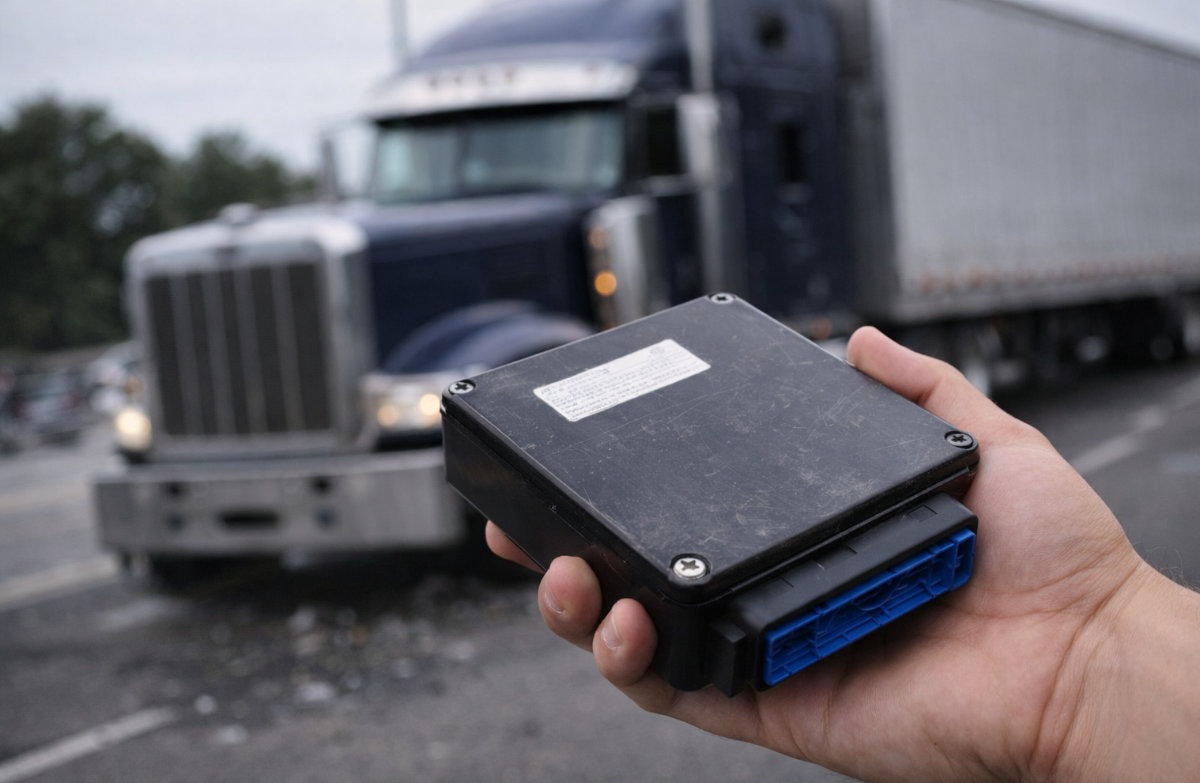
“Black box” is a convenient phrase, but it usually refers to more than one type of electronic evidence. In crash litigation, lawyers, insurers, and reconstruction experts may be talking about an event data recorder, an engine control module, or other onboard systems that preserve vehicle performance information. NHTSA explains that an event data recorder, or EDR, captures technical vehicle and occupant information for a brief period before, during, and after a crash, including pre-crash vehicle dynamics, driver inputs, crash signature, and some post-crash information. NHTSA also makes clear that hours-of-service logs are a different category of data.
That distinction matters in truck accident litigation. A crash-data device may help show whether the truck was braking, accelerating, or traveling at a dangerous speed. An electronic logging device, by contrast, may help show whether the driver had been on the road too long. FMCSA says the ELD rule requires many commercial drivers who must keep records of duty status to use electronic logging devices, and carriers generally must retain ELD records and backup data for six months.
So, when we talk about black box evidence, we are really talking about a broader electronic trail. One part may help explain how the collision happened; another may help explain why it happened.
The Types of Data That Can Strengthen Your Claim
Black box evidence is useful because it can turn a vague argument into a fact-based claim. Instead of relying entirely on conflicting driver statements, your case may be supported by time-stamped electronic data. That can make a significant difference when the trucking company or insurer tries to shift blame.
Common data points may include:
- Vehicle speed: Data may show whether the truck was traveling too fast for traffic, weather, or road conditions.
- Brake application: This can reveal whether the driver attempted to stop and, if so, when braking began.
- Throttle position: Acceleration data may show whether the truck was still gaining speed just before impact.
- Steering or stability information: Certain systems may reflect loss of control or abrupt maneuvering.
- Seat belt and safety system status: In some cases, this helps explain injury patterns and occupant movement.
- Crash timing: Data can help reconstruct the order of events in a multi-vehicle wreck.
NHTSA states that EDR data can assist in crash investigations and help explain the circumstances in which crashes and injuries occur. In a lawsuit, that same function can help establish negligence, challenge a false narrative, or support an expert reconstruction.
How Black Box Data Can Help Prove Fault
In Oregon truck accident cases, liability is not always obvious. A truck driver may say another vehicle cut them off. A trucking company may argue that road conditions were to blame. An insurer may claim your own driving caused the crash. Black box data can help sort through those competing stories by offering something more objective than memory alone.
For example, if the driver claims they were traveling safely, speed data may tell a different story. If the defense says the trucker braked immediately, the event record may show a delayed response. If a collision happened in stop-and-go traffic on I-5 or while a truck was descending at highway speed, the difference between braking early and braking late can become central to the case. These details also tie into Oregon’s basic speed rule, which makes it unlawful to drive at a speed greater than is reasonable and prudent under the circumstances, even if the driver was below the posted speed limit.
Black box data is also useful in comparative fault disputes. Under ORS 31.600, Oregon follows a modified comparative fault system, meaning an injured person can still recover damages if their fault is not greater than the combined fault of the parties against whom recovery is sought; however, damages are reduced by that share of fault. Good electronic evidence can therefore be the difference between a weakened claim and a strong one.
How We Use Black Box Evidence in the Legal Process
Black box data does not win a case by itself. It becomes valuable when it is integrated into a larger case strategy. That means comparing it with police reports, witness statements, medical records, scene photographs, repair records, and, when necessary, expert analysis. NHTSA notes that crash investigations are often augmented by official records and other collected evidence; in litigation, the same principle applies.
Our process commonly includes:
- Consultation: We assess how the crash happened, what injuries occurred, and what electronic evidence may exist.
- Preservation Efforts: We move quickly to demand that the truck and its digital records be preserved.
- Investigation: We gather records, inspect the vehicle if possible, and coordinate with qualified experts.
- Case Development: We use the data to analyze speed, braking, timing, driver behavior, and possible company negligence.
- Negotiation: We present the evidence in a way insurers cannot easily brush aside.
- Litigation: If necessary, we use discovery tools and expert testimony to force disclosure and explain the data in court.
This also affects the settlement-versus-trial equation. A claim supported by strong electronic evidence often places more pressure on the defense in settlement talks. When the evidence is weak or incomplete, insurers tend to become more aggressive.
Black Box Data Can Reveal More Than Driver Error
One of the biggest misconceptions in truck accident cases is that the case begins and ends with the driver. Sometimes the driver made the decisive mistake. In other cases, black box-related evidence and companion records suggest a larger corporate problem. That may include scheduling pressure, poor maintenance, safety-rule violations, or a failure to monitor driver conduct.
That broader picture matters because a trucking company may be liable for more than the simple acts of the person behind the wheel. If speed and braking data suggest late reaction times, we may compare that with hours-of-service records and dispatch expectations. If the truck’s performance suggests mechanical trouble, we may look at maintenance logs. If the crash dynamics suggest something unusual, expert review can help determine whether equipment failure played a role.
In plain English, black box data can help answer two different questions. First, what did the truck do? Second, why did it do that? The first question is technical. The second is where liability often expands.
What Black Box Data Cannot Do, and Why Context Still Matters
Electronic data is valuable, but it is not magic. It does not automatically tell the whole story, and it can be misunderstood if taken out of context. Some devices capture only limited information. Some records require expert interpretation. And some cases involve data gaps, retrieval disputes, or timing questions about when the event was triggered.
That is why we do not treat black box evidence as a standalone answer. We compare it against physical damage, road design, weather, witness accounts, injuries, and the driver’s version of events. NHTSA’s materials reflect the same idea; crash data is useful because it contributes to effective investigation, not because it replaces every other source of proof.
There is also a legal reality here. Even when black box evidence is helpful, the defense may still contest causation, damages, or comparative fault. Oregon’s rules on negligence and fault allocation still apply, and the case still has to be built carefully. Good data helps; careful lawyering is what turns it into leverage.
Let Johnston Law Firm Help You Preserve Black Box Evidence Before It Is Lost
If a truck’s black box data may help prove what happened in your accident, speed matters. Johnston Law Firm can help you take action before electronic records disappear, before the trucking company shapes the story, and before Oregon’s deadlines begin to corner your options. Marc A. Johnston brings substantial litigation experience to serious injury cases, and our firm is built to investigate complex truck crashes with discipline and urgency.
If you were injured in a collision with a commercial truck, contact us for a free consultation. We can evaluate whether black box data, ELD records, maintenance files, and other evidence may strengthen your case, and we can move quickly to preserve what you may need to recover full compensation.
Contact Us for a FREE Consultation
Service Areas
Testimonials
Sally Martinez
– Michelle E.
Mr. Johnston and his firm were incredibly thorough in getting us a fair settlement from our insurance company with little to no pressure. We really appreciated having someone who truly cared about us every step of the way. I would highly recommend the Johnston Law Firm to anyone in need of personal injury representation.