
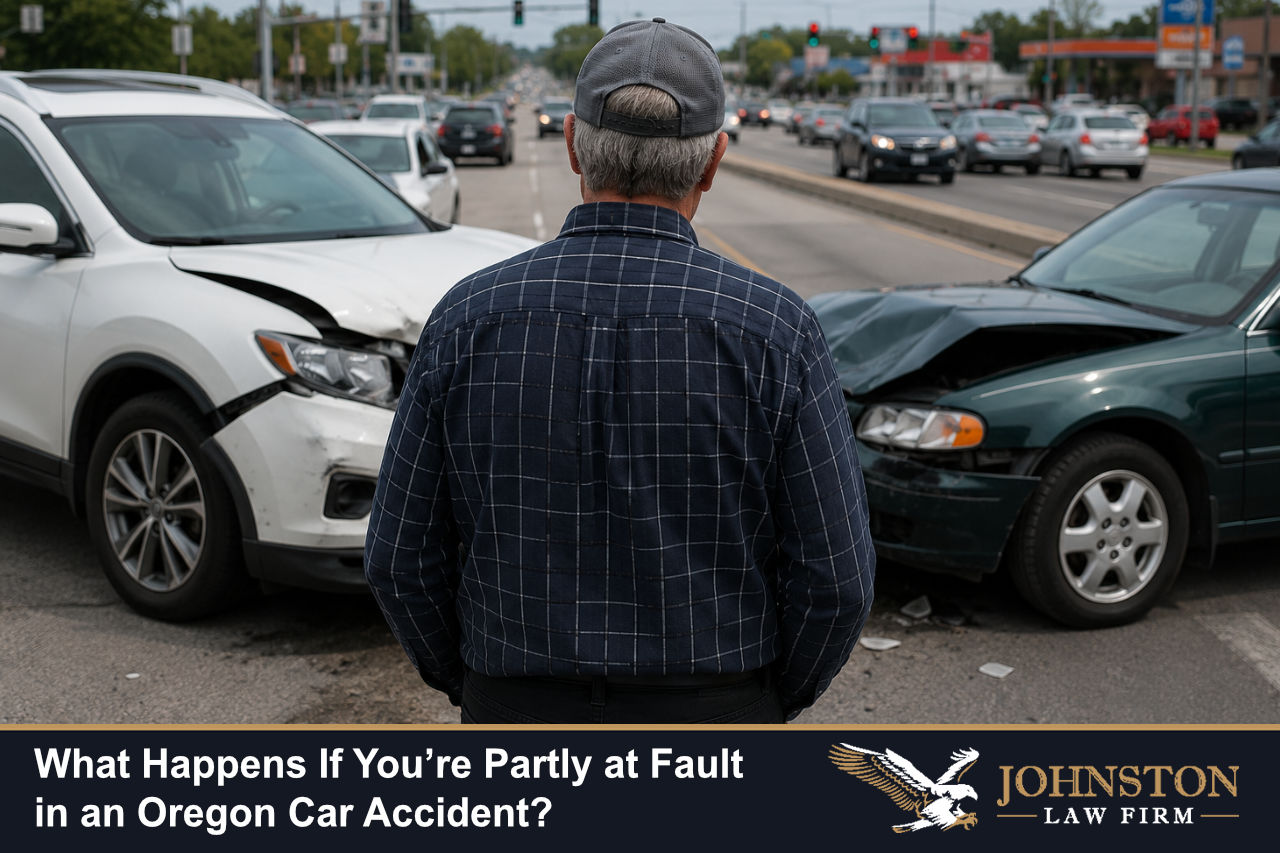
Car accidents are rarely as straightforward as they seem. Some crashes involve a clearly negligent driver, but many involve circumstances where more than one person may have contributed to the collision.
The good news is, being partly at fault does not automatically prevent you from pursuing a claim. Oregon follows a comparative negligence system that allows injured individuals to seek compensation even when they bear some responsibility for an accident. However, the percentage of fault assigned to each party can significantly impact the amount of compensation available. In this post, we’re going to break down in detail what happens when you share fault for a car accident in Oregon and how it may affect your claim.
If you’ve been injured in a motor vehicle crash in Portland or anywhere in Oregon, reach out to a car accident lawyer at Johnston Law Firm. Call us today at 503-546-3167 or contact us online for a free consultation.
Oregon’s Comparative Negligence Rule Explained
Oregon uses a modified comparative negligence system under ORS § 31.600. This law allows accident victims to recover damages as long as they are not found to be more than 50% responsible for the accident.
In practical terms, your compensation is reduced by your percentage of fault. For example, if your total damages equal $100,000 and you are found 20% responsible for the crash, your recovery would be reduced by 20%, resulting in a potential award of $80,000.
However, if you are determined to be 51% or more at fault, Oregon law generally prevents you from recovering damages from the other party.
This rule frequently becomes a major point of dispute in car accident cases. Insurance companies often attempt to increase an injured person’s percentage of fault because doing so reduces the amount they may have to pay. Even a relatively small shift in fault allocation can have a significant financial impact when serious injuries are involved.
How Fault Is Determined After an Oregon Car Accident
Determining fault involves much more than reviewing a police report. Insurance companies, attorneys, accident reconstruction experts, and sometimes juries may all play a role in evaluating how a crash occurred.
Several types of evidence may be used to establish fault:
- Police reports: Officers often document observations, citations, and witness statements.
- Witness testimony: Independent witnesses can provide valuable perspectives on the accident.
- Photographs and video footage: Traffic cameras, dashcams, and cell phone recordings may reveal critical details.
- Vehicle damage analysis: The location and severity of damage can help reconstruct the collision.
- Expert opinions: Accident reconstruction specialists may evaluate speed, braking, visibility, and road conditions.
For example, a driver who was speeding may still recover compensation if another driver ran a red light. In that situation, both drivers may share responsibility, but the specific percentages assigned will determine the final recovery.
Because fault allocation is often subjective, gathering strong evidence early can be one of the most important steps in protecting a claim.
Common Situations Where Shared Fault May Arise
Many accidents involve actions by multiple drivers. Even careful motorists can make minor errors that become factors in a collision.
Some common examples include:
- Speeding while another driver makes an unsafe turn: Both actions may contribute to the crash.
- Distracted driving by multiple parties: Each driver’s conduct may be examined.
- Following too closely: Rear-end collisions sometimes involve shared fault circumstances.
- Failure to signal: Improper signaling can create confusion and contribute to accidents.
- Poor weather conditions: Drivers may be expected to adjust their behavior based on road conditions.
Consider a scenario where Driver A changes lanes without checking blind spots while Driver B is traveling above the speed limit. Both actions may contribute to the collision, leading to a division of fault between the drivers.
These situations demonstrate why fault is rarely as simple as one person being entirely right and another being entirely wrong.
How Shared Fault Affects Your Compensation
Once fault percentages are assigned, the impact on compensation can be substantial. Oregon’s comparative negligence law directly ties your recovery to your level of responsibility.
Example of Comparative Fault in Action
Imagine the following damages after an accident:
- Medical expenses: $50,000
- Lost wages: $20,000
- Pain and suffering: $30,000
Total damages equal $100,000.
If the injured person is found:
- 10% at fault: Recovery may be reduced to $90,000.
- 25% at fault: Recovery may be reduced to $75,000.
- 50% at fault: Recovery may be reduced to $50,000.
- 51% at fault: Recovery may be barred entirely.
This system highlights why insurance companies focus heavily on fault allocation. Their goal is often to reduce financial exposure by shifting as much blame as possible onto the injured party.
Our attorneys frequently work to challenge unfair fault assessments and ensure the evidence accurately reflects what happened.
The Role of Insurance Companies in Shared Fault Claims
Insurance adjusters investigate accidents with one primary objective: controlling costs. While adjusters may appear helpful, they are trained to identify facts that could reduce the value of a claim.
In shared fault cases, insurers often scrutinize:
- Statements made by drivers: Casual comments can be misinterpreted as admissions of fault.
- Medical records: They may attempt to minimize injury claims.
- Social media activity: Posts and photos can be used against claimants.
- Accident reports: Insurers may selectively emphasize unfavorable information.
One common tactic involves requesting a recorded statement shortly after an accident. At that stage, many injured individuals are still shaken up and may not fully understand what occurred. Inconsistent or speculative statements can later be used to argue for a higher percentage of fault.
Because fault disputes can dramatically affect compensation, it is often wise to seek legal guidance before providing detailed statements to insurance companies.
Steps to Protect Your Rights If You May Be Partly at Fault
If you suspect you may share some responsibility for an accident, there are several actions you can take to protect your claim.
Important Steps After the Accident
- Seek immediate medical care: Prompt treatment helps document injuries and supports causation.
- Gather evidence: Photographs, witness information, and accident scene details can be critical.
- Avoid admitting fault: Fault determinations require a full investigation.
- Follow medical recommendations: Gaps in treatment may weaken your case.
- Keep detailed records: Save bills, receipts, wage-loss information, and communications.
- Consult an attorney early: Legal guidance can help preserve evidence and counter unfair fault allegations.
Oregon also imposes strict filing deadlines. Under ORS § 12.110, most personal injury lawsuits must be filed within two years of the accident. Missing this deadline can prevent you from recovering compensation, regardless of the strength of your claim.
Taking prompt action often improves both the legal and practical aspects of a case.
Why Legal Representation Matters in Comparative Fault Cases
Shared fault claims are among the most contested personal injury cases. Insurance companies know that every percentage point matters, especially when damages are substantial.
An experienced attorney can investigate the accident, obtain evidence, work with experts, negotiate with insurers, and present a compelling case regarding fault allocation. This becomes particularly important in cases involving truck accidents, motorcycle accidents, pedestrian injuries, commercial vehicle crashes, and catastrophic injuries.
At Johnston Law Firm, we take a comprehensive approach to accident investigations. We do not simply accept an insurer’s version of events. Instead, we carefully analyze the evidence to identify inaccuracies, challenge unsupported allegations, and advocate for the full compensation our clients deserve.
Our experience handling personal injury litigation and insurance disputes throughout Oregon allows us to anticipate many of the arguments insurers use when attempting to shift blame.
Contact Johnston Law Firm for Help With Shared Fault Car Accident Claims
Being partly at fault for an Oregon car accident does not necessarily prevent you from recovering compensation. Oregon’s comparative negligence laws allow many injured individuals to pursue damages even when they share some responsibility for the collision. However, the outcome often depends on how fault is calculated, the evidence available, and the strategies used by insurance companies.
With extensive experience representing injury victims throughout Oregon, Marc A. Johnston and the team at Johnston Law Firm understand how to address these challenges and pursue favorable results. We handle eligible personal injury cases on a contingency basis, allowing clients to focus on recovery rather than legal expenses.
Contact Johnston Law Firm today for a free consultation. Our team is ready to evaluate your case, explain your legal options, and help protect your rights. Whether your accident occurred in Portland or another Oregon community, we are prepared to fight for the compensation you deserve. Justice Matters. We’re Here to Get It for You!
Contact Us for a FREE Consultation
Practice Areas
Testimonials
Sally Martinez
– Michelle E.
Mr. Johnston and his firm were incredibly thorough in getting us a fair settlement from our insurance company with little to no pressure. We really appreciated having someone who truly cared about us every step of the way. I would highly recommend the Johnston Law Firm to anyone in need of personal injury representation.